
Every Seat at the Table Changed the Conversation

The Modernizing High School Mathematics Summit stayed with me long after it was over. What I remember most is who was sitting around my table, and how each person's experience shaped what they noticed and what they asked.
As the discussion unfolded, everyone returned to what they knew best. The college professors and researchers kept circling back to how we prepare future educators and leaned on years of evidence gathered across classrooms. When the curriculum writer spoke, it was about coherence and how ideas build from one grade to the next. Former district leaders were weighing what it would take to implement anything across multiple schools, and the past classroom educators remembered the reality of standing in front of students every day. We were all examining the same standard, and each of us came at it from a different direction.
I replayed parts of that conversation for days in my head, wondering what might have changed if even one of those perspectives had been missing. We might have asked different questions or overlooked something that seemed obvious to someone who was not in the room, and the whole conversation could have moved somewhere else without any of us realizing what we had lost.
What Every Role Taught Me to Notice
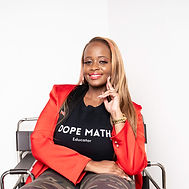
My own perspective has been shaped by the roles I’ve served throughout my career. I’ve been a classroom educator, college professor, curriculum writer, textbook editor, data coordinator, mathematics supervisor, consultant, and founder of my own company. Each role expanded the way I understand mathematics education and changed the questions I bring into a room, and each one also showed me how much still sits outside of what I have lived.
I rode the bus from the hotel to the American Mathematical Society with my sister on the phone. As we passed the Capitol and the Washington Monument, the two of us were whispering about how amazing it felt to be included in a room like the one I was headed into, and before we hung up, she prayed with me. During the panel, the work I had done on the high school mathematics prioritization standards was mentioned and used as a filter for advancing the work of the summit. I felt proud, and for the first time in a long time, I felt like I belonged.
I pay closer attention now to who is participating in conversations and whose perspective may be absent. Decisions are made every day about curriculum, assessment, instructional materials, artificial intelligence, teacher preparation, and educational policy. The people involved influence which questions are raised, which concerns receive attention, and which possibilities are considered.
Some of the most important insight never makes it into these decisions. Families see parts of their children’s mathematical experiences that educators may never see, and classroom educators are trying approaches that are changing how students think but have rarely been invited to share them beyond their own schools. Each of those vantage points shows something about our profession that the others can miss.
Why the Roundtables Exist
I created the State of Mathematics Education Initiative to bring more of those perspectives into the same conversation. I want each Roundtable to include people whose experiences allow them to notice different parts of the same issue. My hope is that participants leave with new questions, a clearer understanding of another person’s perspective, and greater curiosity about the experiences that shaped it.
Our profession is too complex for its future to be shaped through a single lens.
The decisions we make about curriculum, assessment, and instruction become stronger when the people affected by them have meaningful opportunities to contribute to the conversation. That is the table I am trying to set with every Roundtable.
Stay Connected to the Conversation
The State of Mathematics Education Initiative is bigger than a single Roundtable or a single conversation. My goal is to keep creating space for educators, leaders, and others who care deeply about mathematics education to listen, question, reflect, and contribute to what comes next.
If you are not already connected to the DOPE MATH® ecosystem, I invite you to join the waitlist. That is the best way to stay informed about upcoming Roundtables, new conversations, learning opportunities, and other ways to be part of this work. Join the Waitlist
You can also watch the Roundtable conversations on the DOPE MATH® YouTube Channel.
I hope you will continue listening, questioning, and adding your voice to the conversation.
Until next time,
Continue Being DOPE,
Jaliyla Fraser
Creator of DOPE MATH®


Comments