
I Couldn't Find My Voice. That's When I Knew We Had a Bigger Problem.
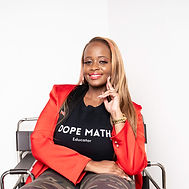

In January 2026, I attended the Modernizing High School Mathematics Summit hosted by Student Achievement Partners, where more than 40 educators convened in Washington, D.C., for two days to provide insight into the high school mathematics prioritization conversation. I found myself sitting around a table with some incredibly brilliant people, including college professors, researchers, leaders, and mathematics education experts whose work I genuinely respect, and for the first time I can remember, I couldn't find my voice. Now, if you know me, you know that doesn't happen. I've never been afraid to speak up in a room, so that moment caught me off guard, and it changed me.
The Room Where I Couldn't Find the Words
We were discussing the future of mathematics education, and eventually the conversation turned to whether a particular mathematics standard should remain a priority in high school mathematics. The discussion was thoughtful, as it was grounded in research and every argument was intellectually sound. Every person around my table was making a compelling case for why this mathematics mattered.
But the more they spoke, the quieter I became.
I agreed with much of what they were saying, and I understood the mathematical purpose behind the topic, its history, and the research that supported it. Still, while everyone else was explaining why the mathematics deserved to stay, I couldn't stop hearing another voice: the voice of every student who had ever looked at me across a classroom and asked the same question, "Ms. Fraser, why do we have to learn this?"
That question has followed me throughout my career, just as I’m sure it has followed every math educator. Students asked it because they genuinely wanted to understand why the hours they spent learning mattered in their lives. As I sat there listening to the conversation unfold, I realized, in that moment, I became my students. I couldn’t for the life of me understand why they needed to learn it. And the even bigger issue, I couldn’t find the language to explain why I couldn’t see the relevance, even though everyone around me could eloquently explain why it was mathematically important.
And that's when it hit me. They had the language to defend the mathematics, while I was searching for the language to defend the student. Those are not the same conversation.
For a while, I just sat there. I even remember one of the facilitators checking in on me because she noticed I wasn’t participating. But the truth is, I was stuck. Paralyzed, even. I kept wrestling with my own thoughts. I remember finally asking everyone to give me a second because I didn't want whatever came out next to sound performative. I had no interest in winning an argument or sounding intelligent enough to belong at the table; I needed to slow down because I had to advocate for my students, and I refused to let that become secondary to sounding polished.
Somewhere in that pause, I stopped speaking as the consultant, the curriculum writer, the professor, or the CEO. I simply became Ms. Fraser (or "Fraser Blood" to some students), the educator who had spent years listening to students wrestle with mathematics and wondering why so many of them struggled to see themselves in it.
The topic was matrices, and I had never understood why they mattered to students. Around my table, the college professors explained that matrices are foundational to things like building video games. I didn't know that, and no textbook I've come across has ever made that connection clear or made it relevant enough for students to want to learn more. So when I finally found my words, I made the case for removing matrices as a standard and told them what students actually experience when they meet this topic: row reducing to RREF, multiplying by scalars, and working through matrix operations with no sense of where any of it leads. For most students, that is the entire experience.
Something shifted after that.
They were appalled. The educators in my group knew how important this mathematics is in their own fields, but they had no idea that the way textbooks presented it was doing the mathematics a disservice by the time it reached students. For the first time, they understood why I was advocating so strongly for removing it as a standard. It happened in the final hours of the summit, and I could feel everyone at our table finally see one another clearly. Our titles stopped carrying any weight, and all of us could feel how much this work matters. We were focused on one thing: helping students reach what we know they are capable of by demanding better from our standards and from our own work.
The Question I Carried Out of That Room
I left that meeting thinking about something entirely different than the mathematics topic we had debated. I kept wondering how many people have sat in rooms just like that one and never found their voice.
I thought about the classroom educators whose insights never reach national conversations because they don't carry the right title, the instructional coaches who notice patterns researchers never hear about, and the district leaders holding questions curriculum writers have never been asked. How many of them leave rooms like that one carrying ideas that could transform mathematics education, convinced their perspective doesn't carry enough weight?
Then the questions became personal. Would I have even been in that room if I hadn't intentionally spent years building experiences across so many different parts of this profession? Finding my voice has never really been an issue for me. I've built an entire career around using it as a classroom teacher, a college professor, a curriculum designer, a textbook editor, a data coordinator, a mathematics supervisor, a consultant, and now the founder of my own company. Every one of those roles gave me another perspective, another opportunity to contribute to conversations like that one, and the confidence to ask the hard question, challenge an idea, or advocate for what I believed was best for educators, families, and students. Even with all of that behind me, I still sat at that table unable to find the words.
But why did it take all of that? Nobody should have to spend years collecting titles before their perspective is taken seriously, and educators shouldn't have to bootstrap their credibility just to earn the opportunity to advocate for the students they know better than anyone else. Too often, we unintentionally create rooms where institutional affiliation speaks louder than lived experience.
I don't want to spend my career as the person who fought her way into spaces where classroom perspectives are finally heard, while the next educator believes they have to build a company, write curriculum, teach at the collegiate level, or collect a list of impressive titles before they deserve a seat at the table. Most importantly, I refuse to let students lose advocates simply because the people who know them best never made it into the room. That's when the vision for the State of Mathematics Education Initiative Roundtable Series became clear.
Conversations That Deserve to Continue
Conversations like the one I experienced shouldn't happen once and disappear. They deserve room to continue beyond a conference schedule, to welcome new perspectives, and to keep challenging how we think about mathematics education long after everyone has gone home. They need to happen over and over again, with different voices, different perspectives, and different lived experiences sitting beside one another. I call the people who bring those perspectives Founding Voices.
Each of them sees mathematics education through a different lens, and our profession is stronger when those perspectives are allowed to meet. They're Founding Voices because each person brings a perspective that our profession cannot afford to lose. A classroom educator sees something different than a researcher, just as a curriculum writer and a principal, or a district leader and a professor, notice different things. None of those perspectives are complete by themselves. Together, they paint a picture that is far more honest than any one of us could create alone.
I wanted to create a space where people could wrestle with difficult questions without feeling pressured to reach quick agreement. My hope is that everyone leaves understanding one another a little more deeply than when they arrived, even if they still disagree, because better understanding leads to better decisions for students.
In this space, people are willing to sit with ideas that challenge them, disagreement becomes an opportunity to learn instead of a reason to divide, and every participant leaves seeing mathematics education through a lens they didn't have when they arrived. I believe that the future of our profession depends on our willingness to make room for voices that have too often gone unheard.
What I Hope This Initiative Makes Possible
If there's one thing I hope this initiative accomplishes, it's this: I hope more educators experience what I experienced at the end of that pause, when I found my voice again. I hope they realize that their classroom experiences, questions, observations, and perspectives matter. Because the future of mathematics education should never belong to one institution, one role, or one way of thinking.
It belongs to all of us.
And I think it's time our conversations started reflecting that.
Stay Connected to the Conversation
The State of Mathematics Education Initiative is bigger than a single Roundtable or a single conversation. My goal is to keep creating space for educators, leaders, and others who care deeply about mathematics education to listen, question, reflect, and contribute to what comes next.
If you are not already connected to the DOPE MATH® ecosystem, I invite you to join the waitlist. That is the best way to stay informed about upcoming Roundtables, new conversations, learning opportunities, and other ways to be part of this work.
You can also watch the Roundtable conversations on the DOPE MATH® YouTube Channel.
I hope you will continue listening, questioning, and adding your voice to the conversation.
Until next time,
Continue Being DOPE,
Jaliyla Fraser
Creator of DOPE MATH®


Comments